Back to News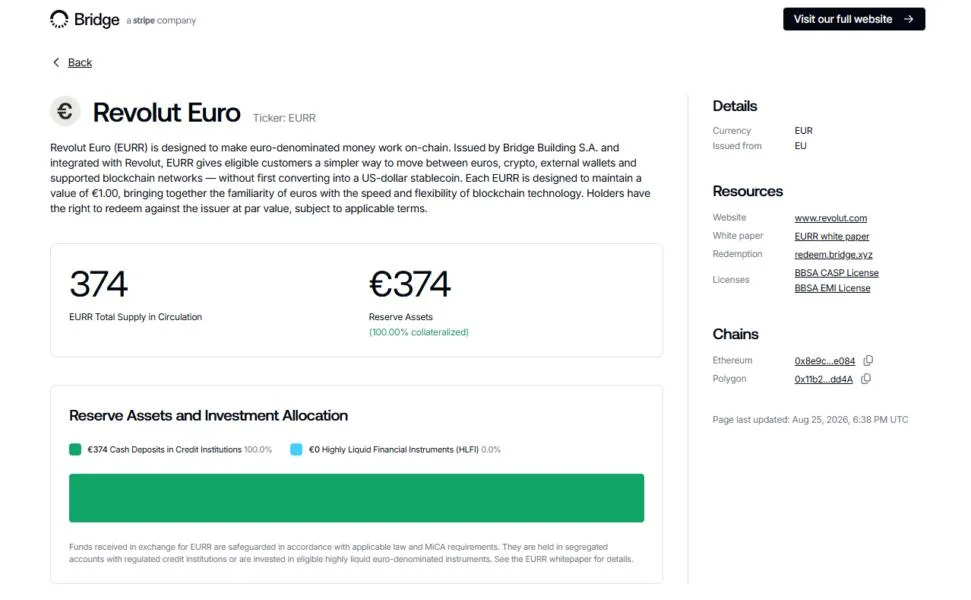
Weekly Review: Revolut Launches Euro Stablecoin; IG Faces Outage
By Exbasi Intelligence
Sourced from Finance MagnatesThis week brought a mix of product launches, regulatory developments and changes across the online trading industry. A new euro stablecoin entered circulation, while brokers faced technical disruptions, regulatory settlements and licence changes.Regulators also turned their attention to CFD protections and operational resilience in an increasingly AI-driven environment. Meanwhile, financial results and shareholder returns offered contrasting views of broker performance, while the prop trading sector continued to diverge between large institutional market makers and retail-funded trading firms.Revolut Enters the Euro Stablecoin MarketRevolut introduced EURR, a euro-backed stablecoin that became publicly available on August 20, with only EUR 374 in circulation when Bridge's reserve dashboard was checked. The token is legally issued by Luxembourg-based Bridge Building S.A., a Stripe-owned company regulated as an electronic money institution and crypto-asset service provider, while Revolut distributes it through its app and Revolut X.Source: Bridge.xyzEURR initially operates on Ethereum and Polygon and is backed one-for-one by euro-denominated reserves. The launch gives Revolut a live euro stablecoin offering under the EU's MiCA framework, although its initial supply remains far below established rivals such as Circle's EURC.IG Resolves Client Login DisruptionIG clients reported login failures across its web and mobile trading platforms shortly before and around the US market open. Users in the UK, Ireland, Singapore and Australia said they were unable to access their accounts, with some reporting problems across multiple browsers and devices.The broker's main website remained available, while outage-monitoring sites and online discussions pointed to problems with account access. IG later confirmed that it had experienced a technical issue that primarily affected client logins and said the problem had been fully resolved. The incident added to a series of recent platform disruptions across the brokerage industry, including reported access problems at Interactive Brokers and other firms.IG Index is reportedly down for hundreds of users right now. Are you one of them? RoboMarkets Settles CySEC CFD CaseCySEC reached a EUR 100,000 settlement with RoboMarkets Ltd over possible breaches of investment services rules, including restrictions governing the marketing, distribution and sale of CFDs to retail clients. The broker has already paid the settlement, according to the regulator.CySEC's review also covered organisational requirements, information provided to clients and procedures for assessing whether investment products were appropriate. The regulator did not disclose the specific practices or incidents behind the possible violations.The settlement follows an earlier CySEC intervention in 2023, when RoboMarkets was ordered to stop offering non-monetary rewards, including race tickets and branded merchandise, to retail CFD clients.FXDD's Malta Entity Surrenders LicenceMalta's financial regulator accepted Triton Capital Markets Ltd.'s voluntary surrender of its investment services licence, ending the former FXDD Malta broker's authorisation after 16 years. The Malta Financial Services Authority said the withdrawal was not the result of regulatory action.Triton had used the licence to provide investment services across the European Economic Area under MiFID passporting rules, a route now closed to the Maltese entity. The company ceased to be licensed on August 25.The development does not determine the regulatory status of separate legal entities using the FXDD brand outside Malta. Belgium had already recorded the end of Triton's freedom to provide investment services there in March.ASIC Prepares Review of CFD RulesSarah Court, Source: LinkedInAustralia's financial regulator said it will consult in the fourth quarter on proposals to amend and extend its CFD product intervention order before the current rules expire on May 23, 2027. The order applies to Australian financial services licensees issuing CFDs to retail clients and currently caps leverage at 30:1 for major foreign exchange pairs and 2:1 for crypto CFDs.It also requires margin close-out and negative balance protections, standardised risk warnings and restrictions on certain inducements. ASIC's timetable places the consultation after an initial review, with ministerial approval planned for the first quarter of 2027. The regulator has not yet specified which provisions could change.ASIC Calls for AI Attack PlanningASIC and APRA called on financial firms to establish decision-making authority and recovery priorities before an AI-enabled cyberattack or other major incident occurs. The guidance followed nine roundtables involving more than 600 participants from over 380 entities. Simone Constant, the ASIC CommissionerRegulators said boards should decide in advance who can escalate an incident, order a shutdown, set recovery priorities and approve crisis communications. The issue extends to retail trading firms, where client access, payments and trading platforms may all require prioritisation during a disruption.Firms were also urged to map critical assets, restrict privileged access, patch vulnerabilities and test backups. ASIC said cyber resilience is a licensing obligation rather than simply an IT issue.Dukascopy Profit Falls Despite Deposit GrowthDukascopy Bank reported a 58% fall in consolidated first-half profit to CHF 1.38 million, as weaker trading and net interest income outweighed stronger commission income. The trading result, the group's largest income line, fell 25% to CHF 8.77 million, while net interest income declined 33%. Net commission income rose 37% to CHF 2.33 million.Combined income from the three core lines fell 18%, while operating expenses were broadly stable. At the same time, customer deposits increased 25% from the end of December to CHF 239.29 million, and total consolidated assets rose 19% to CHF 309.50 million. The interim statement provided no guidance for the second half.Plus500 Starts Another $100 Million BuybackPlus500 began a USD 100 million share buyback, its second repurchase programme of that size in 2026. The London-listed broker is authorised to purchase up to 5.76 million shares under an authority approved at its May annual general meeting.The buyback forms part of the USD 182.5 million shareholder return announced with the company's first-half results, with the remaining USD 82.5 million allocated to dividends. The programme combines a USD 35.3 million interim buyback with a USD 64.7 million special buyback and could continue into 2027.Plus500 said repeated repurchases have reduced its weighted average share count, contributing to a 6% year-on-year increase in first-half earnings per share.Prop Trading Splits Between Two ModelsProp trading continued to show a widening divide between large institutional market makers and retail-funded trading businesses. At the institutional end, non-bank trading firms generated an estimated USD 114 billion in revenue in 2025, while Jane Street reported more than USD 40 billion in net trading revenue over the previous 12 months.Large firms are expanding beyond high-frequency equities and investing heavily in AI, data and computing infrastructure. In retail prop trading, consolidation has coincided with growing demand and a shift towards futures-based evaluations.One industry survey found that a USD 100,000 futures evaluation averaged about USD 193, compared with USD 419 for a comparable CFD evaluation, reflecting changing economics and competitive pressures.
#million#circle#london#reserves#second#and liquidity#bridge#Finance Magnates#Pegs#asic#polygon#one#ai#three#ethereum#Crypto