Back to News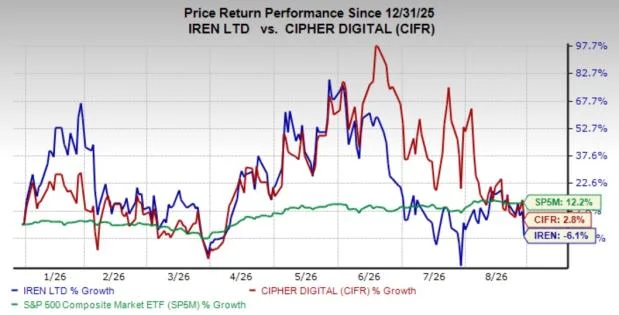
IREN vs. CIFR: Which Bitcoin Miner Is the Better AI Play?
By Exbasi Intelligence
Sourced from ZacksIREN Limited IREN and Cipher Digital Inc. CIFR started from the same advantage — access to large amounts of power built for Bitcoin mining. The infrastructure has become more valuable as AI developers and hyperscalers compete for data center capacity, turning both companies into increasingly direct plays on the shortage of powered sites.Each is now spending heavily to convert that energy footprint into high-performance computing infrastructure while reducing dependence on mining economics. The key difference is how they plan to monetize the opportunity. IREN is moving further up the stack, combining data centers with GPUs, cloud services and software, while Cipher is primarily developing and leasing large data center campuses to hyperscale tenants.This makes IREN more exposed to AI-compute pricing and customer utilization but gives it more ways to earn from each megawatt. Cipher offers longer contracted lease visibility, yet much of its future pipeline still depends on development, interconnection and additional tenant agreements.The Case for IRENIREN’s strongest advantage is that its AI strategy reaches beyond real estate. The company controls data centers, compute and software, giving it a broader revenue model than Cipher’s colocation-focused approach. This matters because scarce power creates the opening, but GPUs and managed services can capture more value after a site is energized.Commercial traction is also becoming harder to dismiss. IREN says $4 billion of annualized run-rate revenues are contracted for 2026 capacity, with $1 billion already operating. Its customer roster now spans Microsoft, Cohere, Perplexity, Figure AI and other AI developers, while a new multi-year agreement adds a leading frontier AI lab. The breadth reduces reliance on one customer type.Execution is moving from promise toward evidence. Horizon 1, the first of four 50-megawatt liquid-cooled deployments at Childress, was delivered to Microsoft, while Horizons 2 through 4 are targeted for the December quarter. IREN is also targeting 0.8 gigawatts of cumulative IT capacity by 2027, supported by a pipeline exceeding 5 gigawatts.Funding remains the main counterweight. IREN expects $25 billion to $30 billion of fiscal 2027 capital spending, an unusually large program that leaves little room for construction delays or weaker financing markets. Still, recent GPU financings and customer prepayments cover most associated GPU spending.Compared with Cipher, IREN is taking more operating and technology risk, but it is also building more direct exposure to AI demand. If management delivers contracted capacity on schedule, the fuller-stack model could translate power access into faster revenue growth and stronger economics.The Case for CIFRCipher’s case starts with contracted infrastructure cash flow. The company has 700 megawatts of contracted gross HPC capacity across three campus leases, with $11.4 billion of contracted revenues and about $793 million of average annualized net operating income over base lease terms. Compared with IREN’s cloud model, this can provide greater visibility.Execution has also improved Cipher’s credibility. Black Pearl began delivering capacity two months ahead of schedule, with rent starting, while Barber Lake is nearing initial delivery and Stingray remains on schedule. The company has also shown it can finance projects, including an $810 million Stingray bond that funded development through substantial completion.The concern is what remains outside those contracts. Cipher’s portfolio totals about 5.3 gigawatts, but roughly 4.4 gigawatts sits in the development pipeline. Several sites still require energization, ERCOT approvals or new tenant agreements. IREN also carries development risk, but more of its near-term AI story is tied to contracted compute capacity and operating cloud revenues.Cipher’s remaining Bitcoin operation at Odessa still contributes cash flow, yet management does not expect additional capital investment there and is exploring an HPC conversion. Second-quarter 2026 revenues fell to $25 million as mining at Black Pearl was decommissioned, showing how the transition can pressure reported results before lease revenues scale.Cipher has valuable powered land, credible construction execution and long-duration tenants. The bearish issue is that investors are being asked to underwrite a large uncontracted pipeline while the existing business is changing, leaving fewer near-term operating proof points than IREN.How Do Estimates Compare for IREN & CIFR?The Zacks Consensus Estimate for IREN’s fiscal 2027 and 2028 sales implies year-over-year growth of 330.12% and 105.48%, respectively. The consensus mark for IREN’s 2027 and 2028 earnings has been revised southward in the past seven days.For IREN:The Zacks Consensus Estimate for CIFR’s 2026 and 2027 sales calls for a year-over-year decline of 3.44% and a growth of 270.62%, respectively. Over the past 30 days, earnings estimates for both 2026 and 2027 have been revised downward, signaling a bearish outlook from analysts.For CIFR:Price Performance and Valuation of IREN & CIFRSo far in the year, IREN shares have declined 6.1%, while CIFR shares have gained 2.8%. In comparison, the S&P 500 composite has advanced 12.2% in the same time frame.On a forward 12-month price-to-sales basis, IREN currently looks less demanding than Cipher. IREN trades at 3.54X forward 12-month price-to-sales versus 10.42X for CIFR.The gap is notable because IREN already has a larger AI cloud revenue base and more direct exposure to compute, while Cipher’s reported revenues still reflect a transition from mining toward lease income. Even so, IREN offers the more favorable relative valuation today. IREN has a Value Score of D, while CIFR has a Value Score of F.ConclusionBoth companies have paths from Bitcoin mining infrastructure into AI data centers, but their risk-reward profiles are different. Cipher has long leases, quality counterparties and a large development runway, yet much of that runway remains uncontracted, and its model captures less of the AI stack. IREN is taking on execution and financing risk, but it has contracted cloud demand, operating AI revenues, broader customers and a fuller technology offering.Combined with the lower price-to-sales multiple, IREN is the stronger stock to consider and retain. CIFR’s strengths remain real, but the shares look better suited for reducing or exiting exposure.While IREN carries a Zacks Rank #3 (Hold), CIFR has a Zacks Rank #4 (Sell).You can see the complete list of today’s Zacks #1 Rank (Strong Buy) stocks here.Zacks' Research Chief Names "Stock Most Likely to Double"Our team of experts has just released the 5 stocks with the greatest probability of gaining +100% or more in the coming months. Of those 5, Director of Research Sheraz Mian highlights the one stock set to climb highest.This top pick is a little-known satellite-based communications firm. Space is projected to become a trillion dollar industry, and this company's customer base is growing fast. Analysts have forecasted a major revenue breakout in 2025. Of course, all our elite picks aren't winners but this one could far surpass earlier Zacks' Stocks Set to Double like Hims & Hers Health, which shot up +209%.Free: See Our Top Stock And 4 Runners UpWant the latest recommendations from Zacks Investment Research? Today, you can download 7 Best Stocks for the Next 30 Days. Click to get this free reportCipher Digital Inc. (CIFR): Free Stock Analysis ReportIREN Limited (IREN): Free Stock Analysis ReportThis article originally published on Zacks Investment Research (zacks.com).Zacks Investment Research