Back to News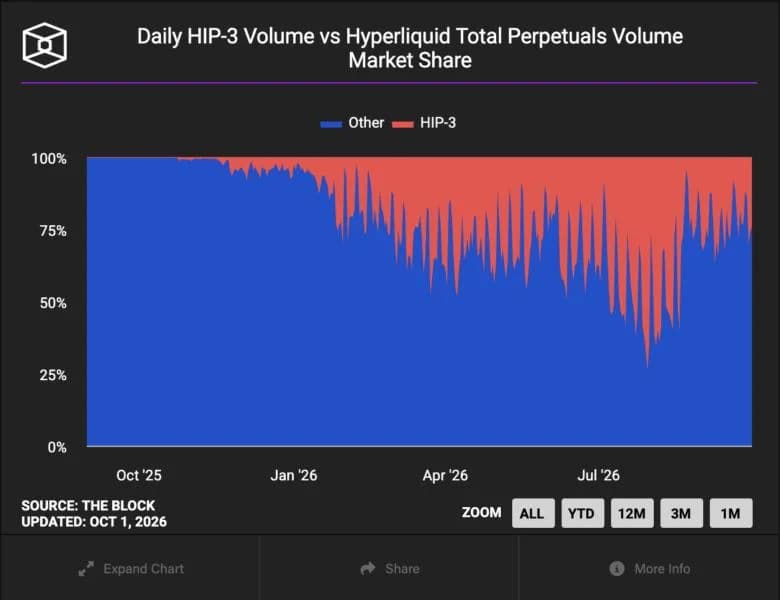
Hyperliquid Policy Center, Circle press EU on perps and stablecoin reserves in MiCA review
The Hyperliquid Policy Center (HPC) wants the European Commission to treat crypto perpetual futures as derivatives under MiFID II, the EU's existing rulebook for financial instruments first passed in 2014, rather than bring them under the Markets in Crypto-Assets Regulation, or MiCA.HPC urged the Commission as such in its response to the Commission's MiCA review, which opened on May 20. The EU's executive body later pushed the deadline from Aug. 31 to Sept. 30, and several crypto and banking firms filed responses in the last few days of the submission period."The Consultation arrives at a defining moment for financial markets, as public blockchains now serve as infrastructure for marketsthat trade continuously and in substantial volume, and regulators in several jurisdictions are working through how regulated products can use them," HPC wrote in its response. "We believe the existing EU frameworks can accommodate onchain products and markets through targeted action without a wholesale revision of their rules."USDC issuer Circle used its submission to the same MiCA review to go after the regulation's stablecoin reserve rules."Of the top 25 stablecoins globally by market capitalisation, only three are currently MiCA-regulated (USDC, USDG, EURC)," Circle wrote in a blog post describing its submission. "This suggests the current gap is not in the supply of new regulated issuers, but in MiCA's perimeter capturing the largest global tokens, and in EU-issued [e-money token issuers] growing at global scale."HPC wants perpetual futures regulated under MiFID IIThe Washington-based HPC was set up in February and funded with 1 million HYPE tokens, then worth about $29 million, from the Hyperliquid Foundation. Its blog post describing the response says the EU response is its first filing outside the U.S.The filing's first point: The classification of financial instruments "should follow the economic features of an instrument, and the ledger on which it is recorded should not be determinative," HPC CEO Jake Chervinsky wrote in the letter, dated Sept. 30. In other words, perpetual futures ("perps") should be regulated under MiFID II, even though they generally run on onchain trading venues.The group argues MiFID II's Annex I derivative categories already capture perps, so no new law is needed. "Clarity in application, rather than new legislation, is what would assist in regulating perpetual futures," HPC wrote.HPC also doesn't want perps lumped in with contracts for difference, or CFDs, which ESMA restricted for retail traders in 2018. With a CFD, "the provider profits when its client loses," the filing said, while on a perps order book, the trading venue isn't itself the counterparty.HPC asked the Commission to require that trading venues publish funding methodologies, maintenance margins and liquidation thresholds ahead of time. The group also wants the Commission to confirm that putting a regulated product on a public blockchain doesn't, by itself, change the product's classification.The filing points to Hyperliquid's own HIP-3 markets as an example. A regulated firm "can build a market on that infrastructure," set leverage limits and restrict access through an onchain allowlist, then "offer that market to its clients as a regulated product," HPC wrote.At one point in late July, HIP-3 markets accounted for 75% of Hyperliquid's overall trading volume, per The Block's data, though that number has since fallen to roughly a quarter of the overall volume in recent weeks.Back in August, HPC made a similar pitch to the SEC and CFTC to classify perpetual contracts by economic structure."The product category has been commercially dormant for many years, though U.S. exchanges returned to it this summer, and its framework will need modernization for new product structures," HPC wrote at the time.Circle wants looser reserve rulesCircle (CRCL) has issued its dollar-pegged stablecoin (USDC) and its euro-pegged EURC in the EU through its French entity since July 2024, and calls itself the largest e-money token (EMT) issuer authorized under MiCA. Patrick Hansen, Circle's director of EU strategy and policy, laid out the company's submission in a Thursday blog post.Circle declined to share the full filing with The Block. "We'll let the blog speak for itself," Greg Vadala, Circle's senior director of global corporate communications, said in an email.Circle's main target is MiCA's bank deposit floor. Right now, EMT issuers have to keep at least 30% of their reserves in commercial bank deposits, and 60% if the European Banking Authority deems the token "significant," a label reserved for the largest coins.That rule "increases exposure to the credit and counterparty risk of the banking sector," Circle wrote. Circle knows that risk firsthand: USDC briefly lost its $1 peg in March 2023 after the company disclosed $3.3 billion of its roughly $40 billion in reserves was sitting at Silicon Valley Bank, which had just gone under.Here, Circle has the European Central Bank on its side. The ECB and the national central banks that make up the European System of Central Banks also called for scrapping the deposit minimums in their response, proposing instead that a set share of reserves mature within one and five working days. Circle wrote that it "concur[s] with the ECB" that the floor should give way to a "less rigid minimum asset liquidity requirement."Circle also wants two limits from the EBA's technical standards (the detailed rules written to implement MiCA) thrown out. One caps exposure to any single government at 35% of reserves, which Circle said makes it "impossible" for dollar-denominated tokens to hold mostly sovereign debt like U.S. Treasurys.The other caps an issuer's exposure to any one bank at 1.5% of that bank's total assets. Under that limit, big issuers would need reserve relationships with "dozens of separate banks," per Circle.Circle's other priority is protecting multi-issuance, where a MiCA-authorized EU entity and a foreign-regulated affiliate co-issue the same global stablecoin. According to Circle, that's currently the only way tokens like USDC can operate inside MiCA at all."Restricting multi-issuance would simply relocate that usage outside the EU's regulatory perimeter," Circle wrote, pointing to the Commission's own 2020 impact assessment for MiCA. Per Circle, that assessment warned a ban on foreign stablecoins would send EU users to offshore providers without MiCA's protections.The ESCB, meanwhile, said in its response that MiCA needs "legal clarification" on whether third-country multi-issuer schemes are permissible in the first place.Other responsesGerman exchange operator Deutsche Börse Group filed on Sept. 29. It proposed a separate category for "settlement EMTs" used as the cash leg in regulated settlement systems, warning that "settlement fails can cascade." Earlier this year, Deutsche Börse announced a $200 million strategic investment into Payward, the parent company of the exchange Kraken.Tech industry group Chamber of Progress filed on Sept. 30. It said consumers should be able to earn rewards on e-money tokens, which MiCA's interest ban currently restricts, and backed keeping multi-issuance with enforceable EU redemption rights.