Back to News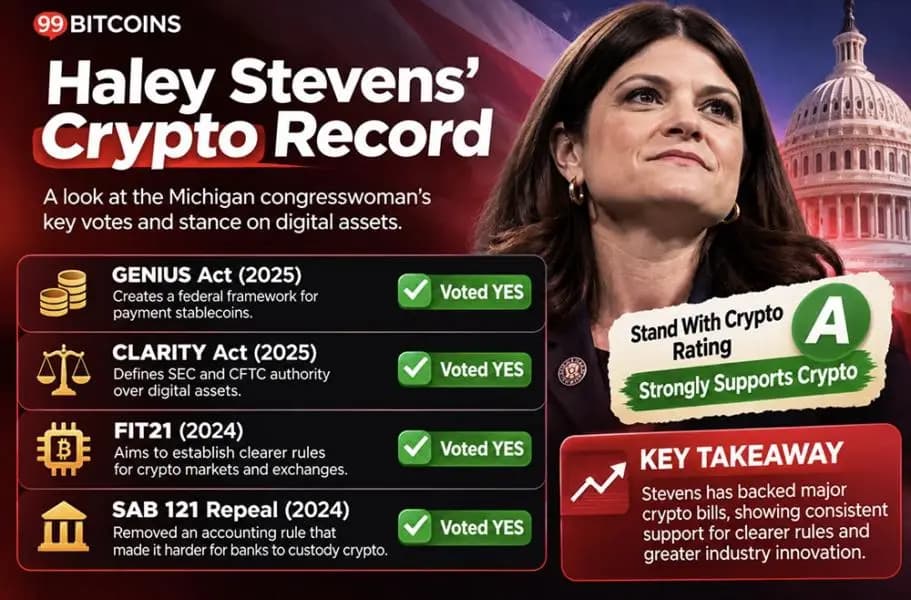
Haley Stevens Backed Crypto Bills: Political Fallout Boost Industry Hopes?
Haley Stevens, a pro crypto politician, has become one of the most talked-about Democrats in Michigan after endorsing Republican Senate candidate Mike Rogers. The decision sparked backlash from party leaders just days before Election Day. But the congresswoman’s political troubles also put her pro-crypto voting record back in the chatter.I am endorsing Mike Rogers for the United States Senate today. Stevens supported several major digital asset bills during her time in Congress, including the GENIUS Act and CLARITY Act. Her record shows that crypto regulation has attracted bipartisan support, even as political divisions deepen across Washington.With Michigan’s Senate race approaching its final stretch, the Haley Stevens story could offer a timely look at how crypto fits into America’s increasingly complicated political landscape.DISCOVER: Haley Stevens Record Includes Major Crypto BillsStevens voted in favor of the GENIUS Act and CLARITY Act in July 2025, two major pieces of legislation aimed at establishing clearer rules for the crypto industry.The GENIUS Act created a federal framework for payment stablecoins, including reserve requirements and oversight provisions for issuers. The legislation marked a significant step toward bringing dollar-backed digital assets into the regulated financial system.The CLARITY Act seeks to establish a clearer division of authority between the Securities and Exchange Commission and the Commodity Futures Trading Commission. Crypto companies have long argued that uncertainty over regulatory jurisdiction has discouraged innovation and pushed businesses overseas.Stevens also supported the Financial Innovation and Technology for the 21st Century Act, known as FIT21, in 2024. The bill sought to clarify how digital assets are regulated and establish a more defined framework for crypto markets.Stand With Crypto, an industry-backed advocacy organization, rates Haley Stevens A for her crypto voting record and public statements.Her support for these measures places her among Democrats who have backed legislation designed to provide the industry with greater regulatory certainty. This matters as crypto companies continue pushing Congress to establish lasting rules for exchanges, stablecoins, and digital asset markets.Could This Political Fallout Boost Crypto Industry Hopes?Stevens’ endorsement of Rogers came after a bitter dispute with Democratic Senate nominee Abdul El-Sayed. The congresswoman lost Michigan’s Democratic Senate primary to El-Sayed in August but initially endorsed him afterward. Their relationship deteriorated in the final days of the campaign, culminating in Stevens’ appearance alongside Rogers in Detroit on November 1.The move triggered criticism from Democratic officials and colleagues, with some describing it as a betrayal. Stevens’ chief of staff also reportedly left her office following the endorsement.The political fallout has placed Stevens in an unusual position. Despite remaining a Democrat, she has publicly backed a Republican candidate in a closely watched race that could influence control of the Senate.For crypto advocates, however, Haley Stevens legislative record offers a separate reason to pay attention. Bipartisan support remains important for digital asset legislation, particularly when bills require cooperation across party lines to advance through Congress.Thank you to everyone working so hard in good faith to get this critical legislation done. Our innovators need clear rules of the road, that’s why I was proud to be one of the earliest supporters of the Clarity Act in the House.Still work ahead, but let’s keep the momentum… Stevens’ votes for FIT21, the GENIUS Act, and the CLARITY Act demonstrate that support for crypto policy has extended beyond Republican lawmakers. Her endorsement of Rogers does not guarantee any change in crypto legislation, but the story shows how digital asset policy can remain relevant even when political alliances shift.The Michigan Senate election takes place on November 3, with the outcome likely to shape the next phase of the state’s political debate.For the crypto industry, the larger takeaway is that regulatory clarity has supporters across the political spectrum. That bipartisan foundation could prove valuable as lawmakers continue debating the rules governing America’s crypto markets.EXPLORE: Follow 99Bitcoins on X For the Latest Market Updates, and Subscribe on YouTube For Daily Expert Market Analysis.The post appeared first on 99Bitcoins.