Back to News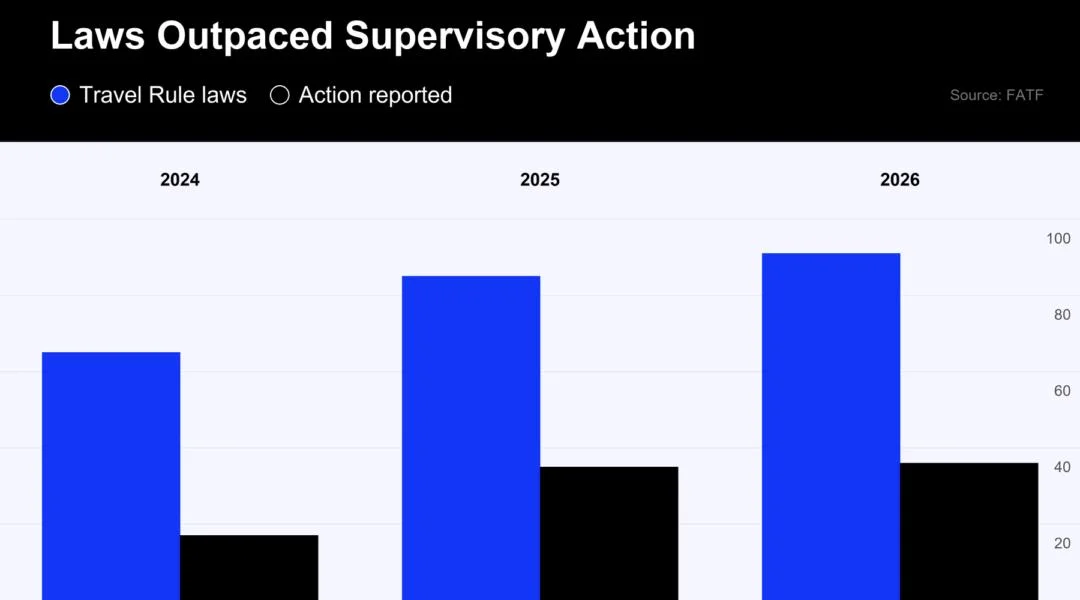
FATF Says 83% Have Crypto Travel Rules, but Action Stays Near 40%
By Exbasi Intelligence
Sourced from Finance MagnatesCrypto Travel Rule laws now cover 83% of jurisdictions answering the relevant Financial Action Task Force (FATF) question, FM Intelligence reported today (Thursday). Only 40% of those with enacted rules reported a focused supervisory or enforcement measure.The full FM Intelligence report counted 91 enacted-law jurisdictions among 109 respondents to that question. Only 36 reported a finding, directive, enforcement action or another supervisory measure focused on compliance.For virtual asset service providers (VASPs), uneven public enforcement does not remove the obligation. It shifts more counterparty checks, data handling and exception management onto firms operating across jurisdictions with different rules and messaging systems.Laws Spread Faster Than ActionThe number of jurisdictions reporting enacted Travel Rule legislation rose from 65 in 2024 to 85 in 2025 and 91 in 2026. Reported action increased from 17 to 35 and then edged up to 36 over the same surveys.That left 55 enacted-law jurisdictions without reported action in 2026, or 60% of the group. The corresponding share was 59% in 2025, indicating that legislation continued to expand without a similar increase in visible supervisory activity.FinanceMagnates.com reported in 2019 that FATF wanted crypto exchanges to transmit originator and beneficiary data with transfers. Implementation has since produced a patchwork of thresholds, counterparty requirements and technical arrangements.The comparison has limits. FATF's annual samples are not a matched-country panel, and the answers are self-reported. Its action measure combines findings, directives, enforcement and other supervisory steps, so the 40% figure is not a penalty count.Operational Burden Moves to FirmsA crypto transfer can settle on-chain before the required customer data reaches the receiving firm. If fields are missing or the counterparty cannot be identified, the assets may remain unavailable to the customer while compliance staff decide whether to credit, hold or return them.[#highlighted-links#]The UK's implementation illustrates that handoff. The Financial Conduct Authority told firms to take a risk-based decision when information is incomplete and kept the UK business responsible when it uses a third-party Travel Rule supplier.Interoperability can also narrow where customers send assets. bitFlyer restricted some transfers in Japan when counterparties used incompatible messaging arrangements, turning a compliance gap into an access constraint.The Gap Is Bigger Than Enforcement HeadlinesFATF's stated goal is transparency around the people sending and receiving crypto. The operating question is whether two regulated firms can agree on the counterparty, jurisdiction, data format and privacy treatment quickly enough for the customer to receive the assets without a manual review.More legislation therefore does not automatically mean consistent execution. Firms still need to test vendor coverage, directory freshness, token support and message interoperability rather than treating the purchase of a Travel Rule tool as the completion of the control.The full FM Intelligence report includes the year-by-year comparison, broader Recommendation 15 ratings, operating examples and the methodology behind each denominator.