Back to News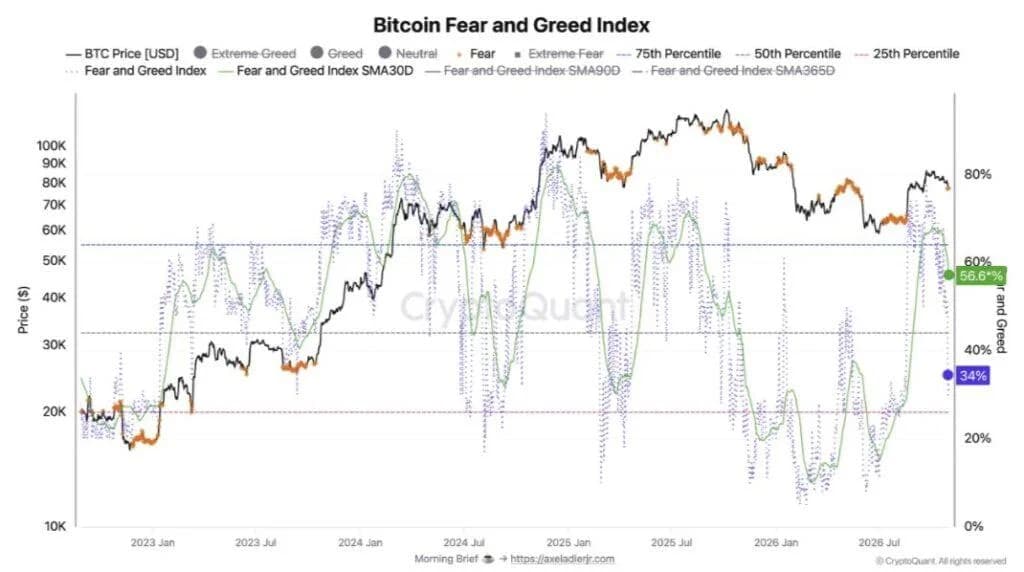
Crypto Fear Index Drops to 30 After Binance Hack as Ethereum ETFs See $1B in Outflows
The developments highlight growing caution across cryptocurrency markets, although available data do not establish that the Binance attack directly triggered the Ethereum ETF withdrawals.Market participants are now monitoring exchange fund flows, institutional investment activity, and cryptocurrency prices for signs of further weakness. The latest and offer additional context as investors assess the market's response to the latest developments.Crypto Fear and Greed Index Falls to 30 After Binance HackAccording to CryptoQuant, the Crypto Fear and Greed Index dropped to 30 on October 30, placing market sentiment in the fear zone for the first time since mid-August. The decline followed Binance's October 29 security breach, which resulted in an estimated $6.3 billion in unauthorized cryptocurrency withdrawals.Bitcoin’s Fear and Greed Index fell to 30, signaling fear among investors following Binance’s record $6.3 billion hack. Source: @cryptoquant_com via XMarket sentiment had already weakened before the incident. The index fell from 68 on October 22 to 51 by October 29, indicating that investors were becoming increasingly cautious ahead of the exchange's announcement. Its latest reading of 30 is also 26 points below the 30-day average of 56. CryptoQuant's historical comparison places the reading below the median of 44, although it remains above the lower quartile of 26.The FBI the Binance attack to TraderTraitor, a North Korean state-sponsored hacking group. The exchange's preliminary investigation pointed to a compromised DevOps engineer's laptop, which allegedly provided attackers with access to internal systems used to authorize withdrawals. Binance said it had found no evidence that wallet private keys were exposed.The scale of the incident triggered an industry-wide recovery effort involving blockchain intelligence firms, law enforcement agencies, and cryptocurrency issuers. Approximately $3 billion in affected assets had been located or frozen through cooperation with industry partners. Binance also said it had covered approximately $6 billion of the estimated losses through its corporate treasury, insurance resources, and Secure Asset Fund for Users (SAFU).The incident has also raised questions about the security of centralized cryptocurrency exchanges and their internal withdrawal systems. Brave New Coin previously examined the breach, its recovery efforts, and the exchange's compensation commitment in its report, Binance Confirms $6.3B Security Breach, Freezes $3B in Assets and Pledges Full Compensation.Ethereum ETFs Record More Than $1 Billion in October OutflowsInstitutional investment activity has also weakened, with US spot Ethereum ETFs experiencing substantial net redemptions during October. A report citing Glassnode data identified 23 consecutive trading days of net outflows through October 30, marking the longest reported outflow streak since the funds launched in July 2024.US spot Ethereum ETFs recorded 23 consecutive days of net outflows through late October 2026, marking their longest withdrawal streak since launching in July 2024. Source: Glassnode via XThe withdrawals extended a period of weaker demand following substantial ETF buying in August and September. October's net outflows exceeded $1 billion, reversing the previous month's $832.43 million in net inflows reported by SoSoValue. The pressure remained visible toward the end of the month, when US spot Ethereum ETFs recorded approximately $155.7 million in net outflows on October 30, according to Farside Investors' daily figures.Farside-based calculations put the full October net outflow at approximately $1.61 billion. This highlights the scale of the monthly reversal, even as some funds attracted smaller inflows during individual trading sessions.There is, however, a difference between the reported 23-day Glassnode streak and Farside's publicly available daily figures. Farside recorded positive aggregate inflows on October 13, October 21, and October 23, with 19 net outflow sessions among October's 22 trading days. The 23-day figure should therefore be attributed specifically to the Glassnode-tracked series rather than treated as a universally confirmed result across all ETF flow trackers.The figures nevertheless point to a clear deterioration in monthly demand for US spot Ethereum investment products. ETF net outflows measure the difference between money entering and leaving the funds, rather than the total amount of Ethereum traded in the broader market. They also do not identify individual investors or establish why holders are redeeming their shares.The reversal is particularly notable because September's positive flows followed heavy institutional accumulation during the summer. October's redemptions indicate that demand through traditional investment products has weakened, placing additional pressure on Ethereum's institutional investment outlook.Binance Withdrawals Reach $4.72 Billion as Exchange Confidence Faces PressureThe Binance incident has created another source of concern for cryptocurrency investors, with customers moving substantial amounts of capital away from the exchange after withdrawal services resumed.According to Reuters, Binance customers withdrew a net $4.72 billion after the exchange reopened withdrawals on November 1. The outflow represented approximately 2.8% of the platform's assets, while Binance reported that $2.7 billion had also flowed back into the exchange. The latest figure exceeds earlier estimates of approximately $3.6 billion as withdrawals continued to be processed.Binance restored withdrawals in phases starting at 06:00 UTC on November 1, 2026, processing $4.649B outflows across 15 networks/assets by 15:30 UTC. Source: Binance via XBinance said withdrawal activity had declined following an initial spike and was stabilizing. The exchange has also maintained that customers will not bear the financial losses associated with the security breach.The response from market observers has been more measured than the initial withdrawal figures might suggest. Tim Sun, a senior researcher at HashKey Group, told Reuters that the incident had not yet caused widespread panic among customers."It has not yet triggered widespread panic or a massive, concentrated withdrawal," Sun said.Nevertheless, the incident could influence how institutional investors, market makers, and other financial participants assess cryptocurrency exchange exposure. Security concerns are particularly relevant for organizations responsible for holding customer assets or providing liquidity across multiple trading platforms.The wider market response has also reflected this caution. Bitcoin ETFs recorded approximately $643 million in net outflows on October 30, while more than $1.3 billion in leveraged positions were liquidated, according to reporting cited by Reuters. These developments indicate that selling pressure extended beyond Ethereum investment products and the Binance platform.Ethereum Staking Reaches Record High Despite ETF RedemptionsDespite weaker institutional demand through spot ETFs, Ethereum's on-chain staking activity has continued to expand. According to Bitwise's third-quarter staking report, approximately 43.8 million ETH was locked in staking by the end of September, representing around 35.9% of the cryptocurrency's total supply.Ethereum staking reached a record 43.8 million ETH in Q3 2026, representing 35.9% of the total supply, according to Bitwise. Source: @BSCNews via XNet staking inflows reached approximately 1.99 million ETH during the third quarter. This marked the sixth consecutive quarter in which more ETH entered staking than left the network. The increase also established a new record for the amount of Ethereum committed to securing the blockchain.However, staking growth has not come without changes to investor returns. Bitwise reported that Ethereum's annualized gross staking yield declined to 2.63% in the third quarter from 2.81% in the previous quarter. The lower yield reflects rewards being distributed across a larger pool of staked ETH.Ethereum's price has also remained above $2,200 despite the ETF withdrawals and broader market uncertainty. Historical market data show that ETH traded near $2,245 on October 30 before recovering toward $2,285 by November 2.The contrasting trends suggest that different groups of Ethereum investors are responding to market conditions in different ways. Investors using exchange-traded products have reduced their exposure, while the amount of ETH committed to network staking has continued to increase.However, rising staking activity does not establish that existing Ethereum holders are directly absorbing the coins associated with ETF redemptions. ETF flow figures and staking deposits measure separate activities, and the available data do not identify whether the same investors are participating in both.For the broader cryptocurrency market, the next developments in exchange security, ETF demand, and Ethereum staking will remain important indicators of investor positioning. A sustained recovery in ETF inflows and the Fear and Greed Index could indicate improving confidence, while continued withdrawals would point to persistent caution across traditional crypto investment channels.