Back to News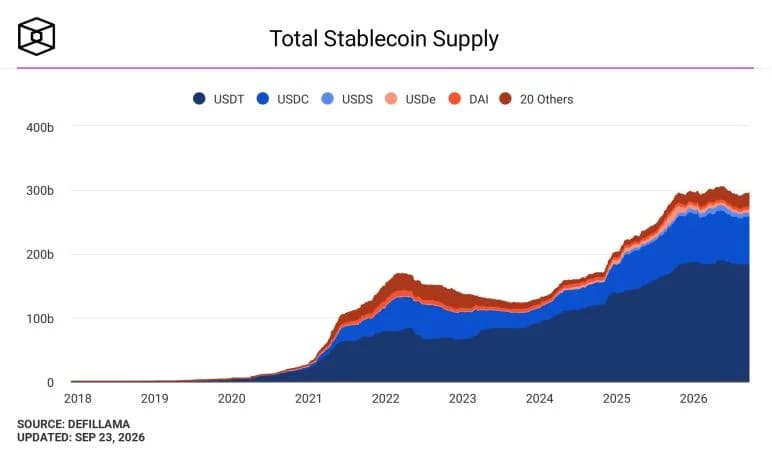
Crypto economy fell just 1.6% in 12 months despite $2.1 trillion market cap rout, Chainalysis says
The global crypto economy contracted just 1.6% during the 12 months ended June 30, 2026, even as the market suffered a 50% decline in total capitalization, according to blockchain analytics firm Chainalysis.Measured crypto economic activity fell by around $100 billion to $9.4 trillion from $9.5 trillion in the 12-month period. The market-cap contraction was far larger at $2.1 trillion, making the period the worst crypto bear market since 2022, Chainalysis said in its seventh annual Geographies report shared with The Block.Stablecoins gain groundAccording to the report, activity was uneven across crypto channels. Value flowing into exchanges, DeFi protocols, and other crypto services fell 4.3% to $8.9 trillion, while domestic peer-to-peer transfers jumped 302.9% to $228.7 billion.Cross-border stablecoin flows rose 77.5%, from $124.2 billion to $220.3 billion, but Chainalysis said its measure is conservative because it excludes transfers where it cannot confidently identify both the sending and receiving countries."This cross-border growth comes from payments that average about $3,000: a transaction size far too small to be institutional," Chainalysis said. "Instead, it aligns with everyday use cases: a person paying a supplier, sending money home, or moving savings out of a currency they no longer trust."Stablecoins also held their value better than other crypto assets during the market decline, per the report. Global onchain balances fell from $860 billion in September 2025 to $440 billion in June 2026, while stablecoin balances remained between $98 billion and $109 billion during the period.Brazil tops adoption indexSeparately, Chainalysis announced its 2026 global crypto adoption index with a new methodology measuring four areas: service inflows, domestic P2P activity, cross-border flows, and onchain balances.Brazil ranked first globally, with a $252.5 billion crypto economy. It ranked third in total flows and domestic P2P activity, fourth in balances, and second in cross-border flows.Meanwhile, the United States ranked second, followed by Nigeria, Japan, and South Korea.Chainalysis said Latin America’s crypto economy grew 9.8% to $593.8 billion during the period, despite Brazil’s own activity falling 1.6%. Mexico, Argentina, Colombia, and Venezuela all recorded growth, with Venezuela’s crypto economy rising 107.2% to $39.1 billion.
More crypto intelligence
- Bitcoin Holds Above $86,000 as Macro Weakness and Short Squeezes Fuel Dominance
- Bitcoin Tests $87K on Soft U.S. Jobs Data Amid Institutional and Regulatory Realignment
- Bitcoin Surges Past $86,000 as Macro Data and Institutional Moves Fuel Leverage
- Macroeconomic Weakness and Bullish Leverage Spur Bitcoin Upside Amid Structural Industry Divergence