Back to News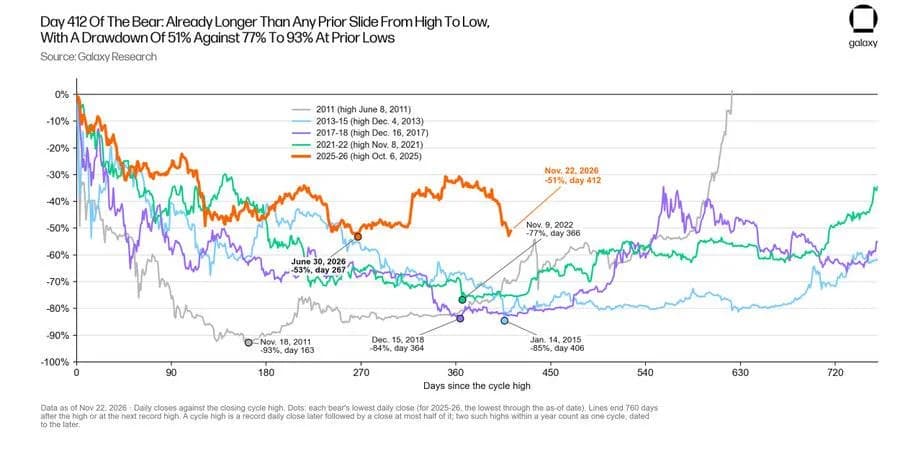
Bitcoin’s bear market is getting old, but may not be done
Bitcoin’s latest bear market has lasted longer than any previous downturn by several measures, yet its decline remains unusually shallow, leaving investors caught between a cycle that looks overdue to end and historical patterns that point to more downside.The cryptocurrency was down 51% from its Oct. 6, 2025, record close as of Nov. 22, marking day 412 of the downturn, according to Galaxy Research. Previous bear markets lasted between 163 and 406 days from peak to trough and ended after declines of 77% to 93%.A recovery signal that failedThe latest weakness has forced Galaxy to withdraw its October assessment that Bitcoin’s bear market had ended in June. That call rested partly on Bitcoin reclaiming its 50-week moving average. The firm had described the 200-week average as “the floor and the 50-week average the ceiling.”Bitcoin moved back above its 50-week average in the week ended Sept. 20, ending 44 consecutive weeks below it. The recovery lasted seven weekly closes before the cryptocurrency slipped back below the average in the week ended Nov. 8. It subsequently closed below its 200-week average in the week ended Nov. 15.Of 13 previous times Bitcoin climbed back above its 50-week average since 2011, only two were followed by a new bear-market low on a daily close, Galaxy said. Both came in 2021-22, one after a single week below the average and the other after 12 weeks. None of the five that followed longer spells below it saw a new low.September’s reclaim looked strong on paper: it followed a 44-week stretch below the average and held for seven weeks. However, the preceding decline was only about 53%, considerably shallower than the 76.7%-92.7% declines preceding the longer historical reclaims.Galaxy noted that two of the three previous reclaims following shallower declines were eventually followed by lower lows. The firm acknowledged that the signal its October call rested on “has failed.”A break of the June low could open a deeper slideThe immediate level to watch is Bitcoin’s June 30 closing low of $58,525. The cryptocurrency closed at $61,104 on Nov. 22, leaving that level intact, although it traded below the July 1 intraday low on Nov. 20 and reached $55,100 on Nov. 21.Galaxy said it would treat a daily close below $58,525 as the start of a move to a materially lower low and would not treat such a close “as a buying signal by itself.”The historical record makes that level significant. In seven previous completed bear-market cases where Bitcoin closed below a low that had stood for at least 60 days and from which it had rebounded at least 20%, the eventual trough was between 17.1% and 66.6% below the broken level. The median decline was 51.8%.Applied to the June low, those outcomes would imply prices of about $48,500 at the shallow end and $28,200 at the median.The current cycle has already seen one such break: Bitcoin closed below its Feb. 5 low of $63,495 on June 5, before reaching the June 30 low 7.8% lower. Galaxy described this as “so far the smallest extension on record.”The clock and the price tell different storiesBeyond the 412 days since the peak, other calendar measures also suggest the bear is running late. As of Nov. 22, Bitcoin was 946 days past the April 2024 halving, compared with 777 to 912 days at the three previous cycle lows. The interval since the previous cycle low had reached 1,474 days, also beyond the 1,153-to-1,431-day range recorded in earlier cycles.But the decline has not reached the depths seen in previous downturns. Bitcoin has not recorded a daily close below its realized price of $53,205, whereas every previous bear market did so for at least 140 days. Galaxy also noted that only two of the 13 bottom signals it tracks had been met as of Nov. 22.The firm sees two possible paths: if the calendar is the better guide, the current downturn could be nearing its end; if historical drawdowns are a better guide, Bitcoin may have further to fall. “We do not believe the price record alone can settle which,” Galaxy said.The researchers said that they were “not trying to call the low,” instead identifying three indicators to watch: whether the June lows hold on a closing basis, whether advisers and wealth platforms continue adding to Bitcoin exchange-traded products, and whether the two-year Treasury yield moves back toward the federal funds rate.At the time of writing, BTC was up 0.1% to $60,447.69. Year-to-date the cryptocurrency was down 32%. Content provided by Seeking Alpha is intended for information purposes only, and that Seeking Alpha does not offer any personalist investment advice and is not a licensed securities dealer, broker, US investment adviser or investment bank.